The Continuing Evolution of the Ethics and Compliance Profession

Scientific Committee of the International Review
of Compliance and Business Ethics

By Keith T. Darcy, President
Darcy Partners Inc.

Introduction

As an organized profession the ethics and compliance world is arguably not more than six decades old. The pattern for its growth and development of the profession is clear – a series of corporate or government scandals followed by increasingly harsh reactions by lawmakers, prosecutors, and regulators. In my careers in financial services as well as in ethics and compliance I have long said, “Wherever there is money there is the potential for corruption. And wherever there is a lot of money there is the potential for a lot of corruption.” These episodes often are accompanied by severe market and economic decline. Warren Buffet, the American billionaire has quipped, “When the tide goes out, that’s when you know who’s swimming without bathing trunks.”

This essay will evidence numerous examples of this pattern, and the punitive consequences that ensue. What was once a heavily legalistic approach to ethics and compliance has increasingly focused on issues of integrity, corporate culture, companies’ relationships to climate issues and the future of business. It is important to remind us all where we have been so that the lessons learned are not forgotten. At the same, we need to follow the arc of the profession to understand where it is going.

The Birth of a Profession

Over the past five decades the ethics and compliance profession has experienced
significant growth and maturity. Unfortunately, much of this has resulted from the many failures of business to self-regulate which so often leads to an unwelcome result – more regulation. In 1974 Richard Nixon resigned as President of the United States which launched a global conversation about ethics, integrity, and character. The following year an investigation of a major U.S. aerospace company was found guilty of making questionable payments to numerous governments and uncovered 400 other companies involved in similar behavior which came forward under an amnesty agreement. This led to the passage of the Foreign Corrupt Practices Act (FCPA), Incredibly, the U.S. thus became the first nation to criminalize the behavior of bribes to foreign government officials. At the same time in Paris, the International Chamber of Commerce (ICC) adopted the Showcross Report and issued ICC’s “Rules of Conduct to Combat Extortion and Bribery.” Clearly, an increased emphasis on internal controls and legal liability laid the seeds for a new profession – ethics and compliance.

Despite these initiatives, issues of malfeasance did not disappear. In 1986 the illegal stock manipulation and insider trading investigation led to a conviction of Ivan Boesky, who spent 22 months in jail, and paid a settlement of $100 million. With Boesky’s cooperation, the junk bond king, Michael Milken, would be fined $600 million and, too, would spend time in jail.

Also in 1986, following allegations of waste, fraud, and abuse among defense contractors, the U.S. defense industry formed a self-regulatory body called the Defense Industry Initiative (DII). Working with the government, DII developed a model for internal ethics compliance programs to detect and prevent waste, fraud, abuse, and other wrongdoings. With the focus on ongoing internal programs relating to behavior and decision making, the compliance function began to take deeper root into the strategies and operations of defense companies.

In the early 1990’s a group of executives from other industries began to draw upon the experience of defense contractors gained through DII. Through the efforts of The Hoffman Center for Business Ethics at Bentley University, executives from non defense companies started exploring the prospects of creating a nonprofit, multi industry membership association where they could come together and share best practices.

Concurrently, on November 1, 1991, the U.S. Sentencing Commission (USSC) issued Chapter 8 of the Federal Sentencing Guidelines pertaining to crimes in the workplace. This landmark pronouncement raised two new risks: (1) a personal threat, and; (2) a corporate threat. The personal threat meant that executives may be subject to civil and/or criminal charges when an employee of theirs commits a crime in the workplace. Willful ignorance and willful blindness will not be considered a defense. In addition, under the corporate threat the company could be subject to mandatory fines up to $290 million. The Commission, however, very creatively offered a carrot along with the stick, i.e. those organizations that take meaningful step to develop effective ethics and compliance programs can mitigate those risks. Chapter 8 also laid out a detailed proscription of what an effective program would constitute. The implications of these new promulgations were not lost on those executives meeting at Bentley University. In early 1992 the Ethics and Compliance Officer Association was formed with nineteen original members. Through this act of mutual recognition, the ethics and compliance profession in the U.S. was born. Since then, similar organizations have been created in many countries across the globe where members collaborate with one another and share best practices, and where the Federal Sentencing Guidelines have become universally cited.

Since then, the evolution of ethics and compliance has been marked by periods of scandals and resulting enforcement responses. During the 1990’s, following deregulation in the energy, utilities, telecom, and financial services sectors the U.S. and global economies soared. Despite major scandals in the 1990s at BCCI in the U.S. and Barings Bank in England, neither of them affected the unstoppable growth in equity markets worldwide. Going into 2001 global economies began to slow and came to abrupt halt following the attacks on September 11, 2001. Shortly thereafter, Enron, the seventh largest company in the U.S. and which never experienced a down quarter in its financial history announced a $3 billion earnings restatement. Within five weeks Enron declared bankruptcy wiping out $63 billion in market capitalization.

Unfortunately, Enron was not the only scandal. Entering 2002, scores of other scandal plagued companies paraded across the newspaper headlines worldwide: WorldCom, ImClone, Tyco, Royal Dutch Shell, VW, France Telecom, Parmalat, Liverdoor, Siemens,
Daimler, Hyundai, Nikko Cordial, Xerox, Rite Aid, Computer Associates, UN Oil-for-
Food, and Arthur Anderson among others. The Dow Jones Industrial Average fell by
50%, and NASDAQ fell by 75 % as shareholders fled to safer investments. These
scandals exposed executive arrogance, fraud, conflicts-of-interest, and the failures of
board oversight, independent auditors, Wall Street analysts, rating agencies, and even regulators. The U.S. Department of Justice extracted heavy penalties from offending companies and imposed deferred prosecution agreements overseen by federal monitors.

Of particular note, in July 2002 the U.S. Congress passed the Sarbanes Oxley Act (SOX) which focused on three specific audiences: the accounting profession, which previously was a self-regulated profession (peer-to-peer) by the creating a government regulator; (2) boards of directors, by imposing strict new demands on their oversight activities, and; (3) senior executives setting out new standards for them managing risk. In sum, SOX was a bill clearly aimed at “tone at the top,” and the implementation of efforts to fortify corporate culture.

Fast forward to 2008, the markets began to once again experience irrational exuberance and uninhibited self-interest. A collapse in the over-inflated real estate markets and mortgage-backed securities which financed them gave birth to The Great Recession, which exposed over two-hundred and fifty Ponzi schemes worldwide, massive frauds, bribery and corruption, insider trading, money laundering, and price fixing. In all $34 trillion in global equities were lost and 20 million people lost their jobs. It took extraordinary measures by central banks everywhere, along with multi-billion-dollar stimulus programs to bring the markets back from the brink of a global depression.

In December 2009 the UN Convention Against Corruption (UNCAC) met in Doha Qatar wherein 150 nations agreed not only to have laws against bribery and corruption (many did but never enforced them), but also decided to hold each other accountable for enforcement. This resulted in significant cross-border cooperation by enforcement authorities heretofore unknown.

In May 2010 the Organization for Economic Cooperation and Development (OECD) issued its Good Practice Guidance on global standards for internal controls. For the first time they added to their promulgations the essential importance of tone at the top, ethics standards, and a culture of integrity, citing the Sentencing Guidelines. In July, the UK Bribery Law was enacted.

In July 2010 the U.S. the congress passed the Dodd Frank Act to tame the overindulgences of Wall Street. Among its provisions included the whistleblower bounty program, wherein anyone from a listed company that brings an issue of malfeasance to the attention of the Securities and Exchange Commission that results in a settlement of $1 million dollars, or more is entitled to receive between 10 and 30%. To date over $1 billion has been paid to such reporters. Several other countries have enacted similar whistleblower programs. Clearly, what was once a U.S.-centric, highly legalistic approach to issues of malfeasance has now converged into global expectations by enforcement authorities everywhere.

Looking Ahead

Where is the ethics and compliance profession today? Despite significant actions and requirements over the decades by enforcement authorities, the professionalization of the ethics and compliance function, and the increasingly sophisticated oversight by governing authorities, risks keep rising. Whack-a-mole issues remain, such as bribery and corruption, money laundering, conflicts of interest, etc. At the same time new risks are constantly emerging. Witness major new scandals at VW, Wells Fargo Bank, Petrobas, VimpelCom, Theranos, Boeing, Deutsche, TD Bank, Uber, and FTX.

The new frontier for risk unquestionably is in the field of technology: hacking; disinformation; cybercrime; ransomware; the dark web, data security; Chat GPT; private messaging sites and; artificial intelligence. One thing we know – technology can inform but can never substitute judgment. Look at the world we live in today:

  • When was the last time you got your Fuji film processed at the pharmacy?
  • Moocs offer online courses which is transforming higher education and the way we learn.
  • Today’s cars park themselves. Tomorrow’s cars will drive themselves.
  • Flying taxis are on the horizon.
  • Your iPhone is a portable mall, a bank branch, bookstore, radio, and t.v.
  • Google allows you to search for anything, anywhere, and anytime – for free. In the process they know exactly where you are, every interest you have, and from which they derive predictive pattern of behavior to sell.
  • The largest transpiration company in the world is Uber – and they own no cars.
  • The largest retailer is Alibaba – and they own no inventory.
  • The largest hospitality company in the world is Airbnb – and they own no real estate.
  • The largest content company in the world is Facebook – and they produce no content.

In addition, given the instant access and universal availability of information corporations are increasingly subject to criticism by the media, competitors, customers, social critics, and even employees themselves. Society today is more informed. Gaps are emerging between a company’s stated values and their business practices. At stake is a company’s trust with every stakeholder.

The C-suite plays an enormous role in support of a company’s E+C efforts. Leaders must develop a culture where employees are encouraged to discuss their day-to-day dilemmas. Lines of communication must be open to stakeholder inside and outside the organization. Today’s leaders must create an organizational culture unhampered by fear. Such leaders are committed to problem finding, not just problem solving. They must embrace error, even failure, because it teaches more than problem solving. They encourage healthy dissent, and reward those brave enough to say no.

The payoff is even more significant. This trust, once developed, will extend to customers, regulators, employees, and the public. It will develop a renewed sense of pride, dedication, and loyalty to the company.

For sure, the role of ethics and compliance executives have become increasingly risky and complex. It is imperative that E+C professionals find ways to partner with other risks managers in the firm, e.g. internal audit, HR, legal, and business leaders. In addition, sharing best practices with colleagues from other firms and industries and learning from them is essential to stay ahead of new and emerging risks, and finding effective ways to mitigate against them. Progress can only be sustained through the collective actions and practical partnerships of committed businesses working together with governments and civil society organizations.

As we look ahead, however, the true measure of success of the efforts of ethics and compliance executives must be seen not just in terms of operational and legal compliance or limiting the liability to the company, but also in how the efforts contribute to the success of the enterprise.
Keith Darcy – Greenwich Leadership Forum

In 2010 I was interviewed at the Greenwich Leadership Forum by my friend David Miller, Ph.D., head of the Princeton’s Faith and Work Initiative. In attendance were senior executives and others from the Greenwich, Connecticut community.

Ethics in the Age of Disruptions – Cahill Lecture

In 2021 I was chosen by the Notre Dame Deloitte Center for Ethical Leadership to deliver the annual Cahill Lecture on Ethics, entitled, “Ethics in an Age of Disruptions.” The lecture was attended by the board of the Center, faculty, and Notre Dame Deloitte scholars.

University of Illinois – Business Ethics Pioneers

In mid-year 2000, the University of Illinois undertook a project to interview a small group of individuals who pioneered and nurtured the nascent and still evolving  ethics and compliance profession. I was privileged to be among the individuals chosen to share our experiences. Driving this project was the effort to capture some of the acquired wisdom for posterity before the lessons learned were lost.

This project was conceived by Patricia Werhane, Ph.D. and Gretchen Winter and resides in the library at the University of Illinois.

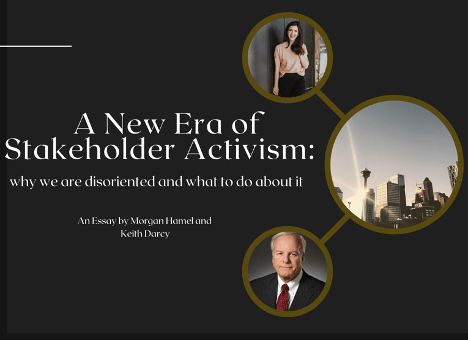
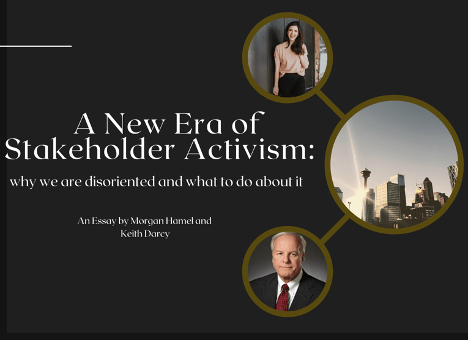
A New Era of Stakeholder Activism: Why We Are Disoriented and What to Do About It – Part 3

By Keith Darcy and Morgan Hamel

Conclusion

The expectations of stakeholders of business have grown substantially over the past several decades and will continue to expand as the awareness and consciousness of society members continue to be raised through advanced media and information delivery systems. Perceiving social responsibility, however, as building shared value rather than as damage control or PR for the firm will require dramatically different thinking in business.

Historically, corporate thinking has viewed markets and, indeed, a firm’s social engagements as a zero-sum game based upon what they can “take” rather than “give.” Some companies continue to view customers and shareowners merely as actors to fulfill their self-interest. Yet recent events have made it clear that businesses can no longer manage or “spin” information that is freely and instantaneously available.

Unfortunately, the values and corporate ethics programs that companies have historically leaned on in difficult times are not providing protection in the way they once did. Rather, they create a high bar by which stakeholders measure action, and inconsistencies are pointed out promptly and publicly.

In addition, while the concept of “stakeholder capitalism” is appealing in theory, implementing it is rife with practical challenges. As Elliot Schrieber points out in his book “The Yin & Yang of Reputation Management: Eight Principles for Strategic Stakeholder Value Creation and Risk Management”:

“Generally speaking, value is the difference between what one gets that is perceived to be of benefit, and what one must give in order to get it. It is difficult to give more value to one stakeholder without diminishing value to others.”

What to Do

In 2012, Facebook introduced the “share” function, and the “like” button began to be used more widely. This, paired with a crisis in confidence for governments globally, has increased expectations for businesses and their leaders and has resulted in an entirely different landscape of business and risk management than that which existed before. Stakeholders have very high expectations of corporations and their leaders for topics that were previously considered the purview of governments. We call this distinction Pre 2012 and Post 2012 and suggest that it has created an environment in which the corporation is essentially naked, with inconsistencies between its formally stated commitments and actual practices exposed for all to see. Those responsible for managing risk, reputation, communications, ethics, ESG or business have good reason to be worried.

We suggest that managing risk in this new era requires that leaders/companies do the following:

  1. Develop skills at the Board and C-suite level to discuss topics that stakeholders perceive as moral/political
  2. Raise awareness of senior leaders/managers/PR/HR/Legal/Ethics/ESG of the rapidly emerging Post 2012 concerns
  3. Review current Speaking Up/Whistleblower Social Media policies/processes with a Post 2012 lens (either add stakeholder activism elements to these policies or develop stand-alone policies/procedures)
  4. Form a cross-functional team to proactively eliminate gaps between formally stated commitments and actual behaviour that could lead to a trust/reputation crisis
  5. Ensure a robust crisis management process to quickly address Post 2012 Problems when they arise
  6. Stress-test the system with cases and recalibrate where necessary

About the Authors

Morgan Hamel is President of MH Partners Inc., an independent consulting firm dedicated to helping firms navigate moral nuance to build long-term stakeholder value. Having earned a Master’s in Applied Ethics from Utrecht University (2010), worked in the ethics office of a large corporation for 11 years, and built a successful ESG-centric fashion marketing company, Morgan brings together the academic, corporate, and entrepreneurial elements of ethics and business in a unique and accessible way. She has a particular passion for helping organizations work through challenges resulting from rapidly emerging stakeholder activism and has a strong desire to contribute to a better world for her two children.

Keith Darcy is President of Darcy Partners Inc., a boutique consulting firm founded in 2002 that works with boards and senior executives on a wide variety of complex corporate governance, ethics, compliance, and reputation risk challenges. Therein he has worked across six continents and in all business sectors. He has combined a 45-year career as a senior executive and corporate director with his passion for education, having taught at The Wharton School for 24 years and served as associate dean and distinguished professor of business at Georgetown University.

A New Era of Stakeholder Activism: Why We Are Disoriented and What to Do About It – Part 2

An Essay by Keith Darcy and Morgan Hamel

Previously, employees and other stakeholders were reluctant to raise concerns and lacked an effective means to do so. Today, however, social media has changed the game completely – stakeholders everywhere have awakened to their power to demand seismic changes in the way businesses conduct themselves.

A report from the law firm Herbert Smith Freehills (HSF) warns of an unprecedented rise in workplace activism across all sectors and geographies, with 95% of respondents envisaging a rise in employees making their voices heard over social media in the next five years. Respondents to the survey said that workforce activism could result in a loss of revenue up to 25% per year.

We’re seeing this play out in real-time as global companies (still catching their breath from the pandemic) race to distance themselves from doing business with and/or in Russia. Hundreds of companies have ceased or suspended operations in the country, and while these actions feel appropriate to many witnessing the atrocities, devastation, and loss of innocent life in Ukraine, it raises questions about which causes companies care about, and how far they are willing to go to satisfy which stakeholders.  Management consultant Laurence Duarte points out that some are questioning whether companies should have to take a stand against Russia, given strife elsewhere in the world. She raises the point that if brands act in Russia they might be asked to do the same in China over human rights violations or where their business interests may be significantly larger.

Witness Disney’s CEO Bob Chapek’s late response to the “Don’t Say Gay” bill signed into law by Florida Governor Ron DeSantis. It was later disclosed that Disney had made political contributions to lawmakers who voted for the bill. Mr. Chapek’s memo to employees seeking to explain Disney’s silence on the anti-LGBTQ legislation poured gasoline on the issue instead and immediately started the hashtag #Boycott Disney movement. He later announced a $5 million grant to the Human Rights Campaign, which immediately rejected the offer and immediately removed Disney’s name as a corporate sponsor of their annual gala. Since this company crisis emerged Disney’s stock fell over 15%. Until this issue arose Disney has long boasted of its efforts for being at the forefront of the LGBTQ+ movement.

Similarly in Texas, 65 corporations – including IBM, Apple, and Capital One – signed a letter in the Dallas Morning News opposing Governor Greg Abbott’s investigation of instances where young children are being treated for transitioning. More recently, Citigroup announced it would pay travel costs for employees affected by the restrictive abortion law in that state. Uber, Match Group, and Salesforce have introduced similar policies, and the leak of Roe v Wade has ratcheted up pressure on corporations.

This poses a significant challenge for leaders and companies who have so far been able to squeak under the stakeholder activism radar with neatly framed board room posters highlighting corporate values like “integrity”. As Alison Taylor – executive director of Ethical Systems and adjunct professor at the Stern School of Business – points out, “The Roe v. Wade leak shows that cynically stoking the culture wars for short term brand advantage is ultimately a pyrrhic victory. Internally, stakeholder capitalism rhetoric has unleashed armies of purpose warriors who know that if their demands aren’t met, strategic leaking offers a powerful form of leverage. Externally, touting your “purpose” can stoke domestic and international political risk.” Executives find that increasingly they have to take a stand on divisive social issues such as reproductive rights because their workforce and customer base has strong opinions on the subjects. The challenge? Stakeholders don’t always feel the same about moral topics in business. These issues can have significant implications for recruitment and retention of employees and on customer loyalty.

These are just a few instances where stakeholders’ perceptions of what’s right or moral can have enormous implications for companies and their leaders whose personal reputations are at risk if they’re caught flat-footed. All it takes is for an issue to go viral to impact employee and customer responses, as well as to affect shareholder value.

Stakeholder Activism – Employees

It is an age of restructuring, re-engineering, rightsizing, reorganizing, and flattening of organizations. As employees reluctantly trade the comforts of the old social contract (job security for modest pay), dependence upon and loyalty to the company has been replaced by estrangement and cynicism.

Employees, customers, and shareholders are putting pressure on companies to make public commitments regarding pressing issues such as: diversity, equity and inclusion (DEI); climate change; pandemic safety; environment, social and governance (ESG); and Russia’s war Ukraine. A recent Financial Times survey asked business leaders where the greatest pressure to speak up was coming from. More than 70% cited employees. Attracting and retaining employees today depends upon acting on the company’s stated values, something especially important to Generations Y and Z, who make up the majority of today’s workforce.

Failure to respond to stakeholders in a way that they find satisfactory can have extremely negative consequences for both leaders and their organizations. In 2018, for example, 20,000 employees of Google walked out to protest sexual harassment, racial and gender discrimination, and an end to forced arbitration. Among the issues was the severance payment of $90 million to one of the company’s top executives who resigned in a sexual harassment case.

Similarly, in 2019, over 4 million employees in 150 countries walked out to protest the lack of urgent plans by businesses worldwide regarding climate change.

The cost for leaders who fail to adequately navigate the moral demands of their employees is high. In 2020, Yael Aflalo, CEO of fashion brand Reformation, stepped down after accusations of racism by a former employee, only to be found “not racist” in an investigation. The report, conducted by the law firm Morgan, Lewis and Bockius LLP and published in October 2020 found the “workplace culture is not ‘racist’,” and asserted it “did not find any evidence that [former CEO and founder Yael Aflalo’s] conduct toward any Reformation employee was racially motivated.” Aflao’s reputation was nevertheless severely compromised.

Stakeholder Activism – Shareholders

Over the past decade, there has been a dramatic increase in shareholder activism to exert pressure on management regarding certain issues. Some of these include:

  • Racial and gender gaps, including on boards of directors demanding plans for improved diversity, equity, and inclusion
  • Environmental, social and governance (ESG) plans by the company
  • Excessive executive compensation viz a viz the rank and file
  • Governance weaknesses
  • Purpose versus profits as well as stakeholder capitalism

Increasingly, shareholders look to business as critical to leading change on a variety of social issues, especially given the inability of governments to effectively deal with them.

Last year, a case example occurred when Engine No. 1 purchased a very small stake in Exxon/Mobil, and enlisted support from BlackRock, Vanguard and State Street Bank. It enabled Engine No. 1 to place three directors on Exxon’s board to accelerate plans to reduce carbon emissions, the failure of which would have significant negative consequences on its long-term financial performance. Subsequently, Exxon’s shares have risen dramatically.

Elsewhere, Goldman Sachs is subject to a class-action lawsuit by several teachers’ unions for securities fraud resulting in $13 billion in losses from material misstatements and failure to disclose conflicts of interest. Specifically, the shareholders claimed Goldman made generic representations in earlier SEC filings that inflated its stock price, including: “We have extensive procedures and controls that are designed to identify conflicts-of-interest; honesty and integrity is at the heart of our business; our representation is at the heart of our business;” and “our clients’ interests always come first.” The Supreme Court returned the case back to the Second Circuit Court of Appeals for clarification.

The outcome of this case will have significant ramifications. Can organizations be held legally accountable for their words, stated beliefs, and values or are they merely marketing slogans which have no meaning? In an age of “purpose over profit;” ESG (environment, social, governance) and corporate responsibility statements are proliferating companies may now need to be extremely cautious in their public pronouncements. However the Goldman Sachs case is resolved, executives must be reminded that words without actions are an empty chalice, and stakeholders everywhere are taking notice. The focus on social issues by shareholders has risen dramatically and represents an important seismic shift in long-term investing.

Stakeholder Activism – Customers

Given the extraordinary availability of information, customers (as well as employees, shareholders, and regulators) are acutely aware of gaps between a company’s stated values and its actual practices. Company brands can be destroyed by overstating intentions or worse, exposing significant gaps between their words and actions. The organization “Brand Trust” surveyed over 12,000 people globally and found that 71% said that if they perceive a company as prioritizing profit over people, they’ll lose trust in the company forever.

The challenge for all businesses today is significant: customers are looking for leadership on issues of real consequences, and they are aligning their dollars with their ideals. Indeed, 58% of Edelman Trust Barometer respondents (2022) said they would buy or advocate for brands based on their beliefs and values. Issues demanding attention include:

  • High cost of healthcare
  • Education
  • Climate change and sustainability
  • Gender equity
  • Racism
  • Inclusion
  • Gun violence
  • Voting rights
  • Etc.

Protecting a company’s brand is essential to its long-term success. Companies that have suffered the consequences of their actions include:

  • Uber’s loss of subscribers when its frat culture was exposed.
  • VW and its involvement in creating “defeat devices” to manipulate the EPA carbon emission tests cost the company over $40 billion in settlements and lawsuits, as well as an extraordinary loss of reputation.
  • Wells Fargo and a completely misguided compensation system that led to cheating their customers caused long-term brand damage.
  • And in the recent trial of Elizabeth Holmes, ex-CEO at Theranos, the defence argued unsuccessfully that her public claims of success were mere puffery and aspirational.

In a crowded marketplace, companies strive for a unique selling proposition that can separate them from the competition in the minds of consumers. Customer loyalty can be built upon those companies whose distinctive ethical values are outward-facing and stakeholder supportive. Companies like Starbucks, Patagonia, Wegman’s, and Costco have long understood the benefits of good corporate citizenship. These companies have a distinct advantage in that they were clear about what they stood for in the beginning. Companies late to the “purpose” game are wise not to overstate their commitment to social causes lest they be accused of being inauthentic and “purpose washing.”

Stakeholder Activism – Communities

Peter Drucker believed that firms were accountable to society beyond the bottom line. According to Drucker: “Free enterprise cannot be justified as being good for business; it can only be justified only as being good for society.” Drucker’s primary focus was on creating and satisfying customers and those external to the enterprise. Thus, as social issues arise creating negative externalities impacting the community, he believed business had social obligations to address them. 

The recently released Edelman Trust Barometer Study found that stakeholders do not believe business is doing enough to address societal issues (52% on climate change; 49% on economic equality; 46% on workforce reskilling).

As companies attempt to position their activities as values-based and beneficial to their stakeholders, they are increasingly being challenged to put their words into action. For example, Lululemon, Canada’s official sponsor of the Olympic and Paralympic games recently faced criticism in Calgary when stakeholders pointed out that one of their stores was not wheelchair accessible.  The City of Calgary was pulled into the controversy when it was disclosed that local laws prohibited changes to the heritage building that would allow wheelchairs. Situations like this, where unknowing organizations (in this case, The City of Calgary) are unwittingly pulled into a moral controversy are becoming commonplace.

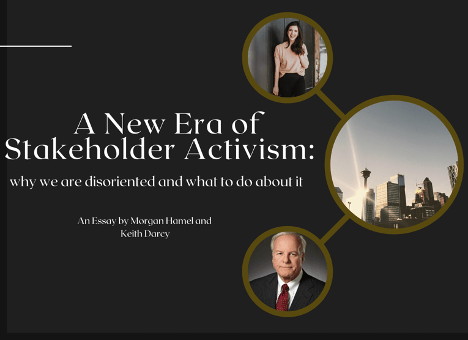
A New Era of Stakeholder Activism: Why We Are Disoriented and What to do About It

By Morgan Hamel and Keith Darcy

Part 1

Background

In 1970, Alan Toffler and his wife, Adelaide Farrell, wrote a best-selling book, Future Shock, wherein he defined the title of the book as “disorientation due to premature accelerated change.” Toffler wrote that the speed of change leaves us confused and disoriented. Looking back, however, the environment in 1970 looks more like a three-layer cake compared to today’s increasingly complex world. As the once familiar maps and guideposts blur, we grope into the future seeking a new understanding of the world and our responsibilities in it

Today’s extraordinary speed of change has contributed to an age of disruption:

As if these issues aren’t enough, leaders everywhere are keenly focused on Russia’s invasion of Ukraine and its potential impact on businesses everywhere, as well as concern for the potential for the war expanding into NATO territory.

No one is immune from these issues. Board members, C-suite leaders, ethics and compliance executives, ESG professionals, management consultants and academics have been shaken by world events and trends leaving them “disoriented.”

In days past, companies relied upon well-written statements of values, codes of ethics, sustainability reports and PR campaigns to address stakeholder concerns. The corporate world order as we knew it, however, isn’t what it used to be. It has taken on a moral dimension that presents new challenges to leaders everywhere. A quote by the renowned ethics professor Kirk Hanson captures this shift:

“I am convinced we are now seeing a long-term trend, indeed, a megatrend, that companies, boards, and business associations will (be forced to) speak out on a limited set of issues many will still call political but are actually critical ethical questions. The challenge for companies is to be able to recognize the genuine moral issues and act on them before inaction destroys public confidence in them.”

While one may or may not agree with Kirk Hanson’s framing (Joe Zammit-Lucia makes a compelling argument that these issues are political), many stakeholders view issues that were previously the purview of governments as “moral” and as topics that require action by business and their leaders. Companies are wise to realize this.


About the Authors

Morgan Hamel is President of MH Partners Inc., an independent consulting firm dedicated to helping firms navigate moral nuance to build long-term stakeholder value. Having earned a Master’s in Applied Ethics from Utrecht University (2010), worked in the ethics office of a large corporation for 11 years, and built a successful ESG-centric fashion marketing company, Morgan brings together the academic, corporate, and entrepreneurial elements of ethics and business in a unique and accessible way. She has a particular passion for helping organizations work through challenges resulting from rapidly emerging stakeholder activism and has a strong desire to contribute to a better world for her two children.

Keith Darcy is President of Darcy Partners Inc., a boutique consulting firm founded in 2002 that works with boards and senior executives on a wide variety of complex corporate governance, ethics, compliance, and reputation risk challenges. Therein he has worked across six continents and in all business sectors. He has combined a 45-year career as a senior executive and corporate director with his passion for education, having taught at The Wharton School for 24 years and served as associate dean and distinguished professor of business at Georgetown University.

At 50

For Lynne
by Keith Darcy

On June 17, 1972 I married the love of my life.

We met in college when I was a senior and she a freshman. It was love at first sight. I was immediately smitten by Lynne, a beautiful brunette filled with sunshine, unbridled joy, and optimism. It was at a time when my world was shrouded by darkness and seemingly without hope. I was quickly drawn to her radiance. There was an energy I had never witnessed or experienced before, or since. She was fully alive, while I was struggling through significant first family dysfunctions and rejection.

We were both young, innocent, with visions of an exciting journey together. Little did Lynne or I know how chaotic the road would be that lay ahead of us. Despite all the family wars to be fought, Lynne was constantly leading us to embrace all that life has to offer. She was never deterred, always hopeful that something positive would emerge just around the corner. Notwithstanding all of my doubts and negativity, she made me believe that anything and everything in life was and is possible. To this day she remains a constant, a rock in a world that had been ever changing and challenging around us. Her presence is fully ennobling.

***

As a youngster and teenager, I was shy, afraid of rejection (a natural development from having been emotionally abandoned and abused by my family). I dated very little during my formative years. I imagined that, perhaps someday in my late thirties, I might settle down with someone, who, like me, shared the awkwardness of searching for a mate. I never envisioned that love, real love, was something I would experience. I didn’t know what it was. And then, this beautiful brunette in a mini-skirt landed in my lap – and fifty years later continues to walk with me and illuminate the road ahead.

Trying to find words to describe Lynne does not easily capture her essence.

First and foremost, she has always been the greatest wife, mother, best friend, and love of my life.

As mother of our children, Lynne did everything for our kids. She created an art box for Erin and set up a drum set for Tim, encouraging their creativity. She planted flowers with them in the spring, swam with them in the summer, played in piles of leaves in the fall, and built snowmen in the winter. When it rained, she painted their faces, took them everywhere they needed to be, and gave them unconditional love. She was there, always there, even when I wasn’t, physically or emotionally.

Without Lynne, my life most certainly would have been entirely different. David Brooks wrote in his book, The Social Animal, “Ultra-motivated people are driven by a deep sense of existential danger. They often meet someone who shows them the way, and who fires their sense of possibilities.” It was Lynne who orchestrated my salvation from an emotional dungeon.

She supported all my career decisions, including the many bad decisions I made. I can’t imagine what she thought when I decided to go to seminary in my mid-30’s and, later, when I told her I wanted to quit a successful career in banking to embark on a journey in a then non-existing profession in business ethics. She never hesitated. During that time there were over two years where I earned less than $40,000 collectively, which was especially painful and financially punitive at a time when Erin was going off to college. She remained my rock. I remember that night in a restaurant on M Street in D.C. when she asked me if I wanted to quit my prestigious position at Georgetown and return to New York. She was enjoying her experience living in Washington, D.C. immensely, and teaching at The National Cathedral School. She could see, however, that I felt defeated and depressed. Once again, she subordinated her needs and interests to mine.

Ten days before her fiftieth birthday, I was sitting in my home office and was inspired to write an article about her. When finished, I neatly put it in an envelope and mailed it to a local newspaper. What follows is an excerpt from that article written 21 years ago.

***

The person who has had the greatest influence on my life is my wife and sweetheart, Lynne. In June 2020 we will be married 29 years. She entered my life 32 years ago as a college freshman, jumping on my lap as I sat in the passenger seat of an open Jeep on campus and introducing herself. She was simply adorable, had legs all the way up to her neck, and a smile that radiated through me. I never felt such an energy and life force in my life. It was this energy that eventually carried me out of the darkness of a home plagued by alcoholism. She showed me that I could have a life worth living.

I have learned many things over the years from Lynne. She believes life is not something you plan in advance, but an adventure to be lived every day with new possibilities ever present. Flat tires, interruptions, and job loss open different paths to be explored.

The poet David Whyte wrote, “You’ll know you’re on the path (to happiness) when the path in front of you disappears.” Lynne has lived on the Path of Life for as long as I’ve known her. She has long espoused that life is the gift we have been given. What we do with our life is our gift in return. As the Buddha observed, “The Great Way is not difficult. Only do not make distinctions. Take away the likes and dislikes. Then everything is perfectly clear.”

Given this clarity about life, Lynne has an astonishing sense of truth and lives in it. Her grounded-ness, and the exciting possibilities of abrupt change, allows her not to live in some delusion of the present or future. The truth is the truth. It is both compelling and disarming and, to some that live outside reality, possibility threatening. In all, it is part of the life force that Lynne exudes.

Lynne has a child-like innocence. She sees the world as simple and fundamentally good.  She lights up observing the spontaneity of children, animals, birds, and people. The beauty of sunsets, full moons, storm clouds, and snow mesmerizes her. She gasps at the majesty of mountains and the song of the river. She sees the reflections, hears the acoustics, and understands the rhythm of life as no one I have ever known.

Because of Lynne, I can now see every leaf on every tree, enjoy the taste of pancakes, inhale the smell of church, feel the dew on the grass, and experience perpetual dawns. I am no longer at war with the world. I am in love.

For 32 years, Lynne has, through the sacrament of presence, taught me the joy of living. “Tomorrow is a new day. I wonder what adventure will be in store for us,” she constantly proclaims I have never met a more beautiful person in my life, inside and out. She is a generous, caring, loving person. I truly believe there was divine intervention when Lynne came into my life. I have been extraordinarily blessed in this, our shared journey.

                                                                        ***

I haven’t always been easy to live with. But, then again, no one said life would be easy. We’ve grown old(er) together and gotten used to each other. We finish each other’s sentences and read each other’s mind. At this stage of my life, however, I never take for granted how lucky I am to share my life with the greatest person I have ever known.

Lynne’s the one that could always see the light, especially when I couldn’t. She still fascinates and inspires me and remains the number one earthly reason for my existence. We are now married 50 years. I cannot imagine a life without her. I am saddened only by the realization that someday it is likely I will leave this life before her (the women in her family live forever). Despite that, I know the day will come thereafter when I will be re-united with a beautiful brunette, who will greet me and will then jump in my lap, and we will live eternally in love, forever.

Lynne Darcy, I am madly in love with you, have been since the moment I saw you, and will always be.

***

Proverbs 31: 10-11

Who can find a good woman?
She is precious beyond all things.
Her husband’s heart trusts her beyond all things.
She is his best reward.

“There are souls in this world who have the gift of finding joy in everything and leaving it behind them when they go.”

Frederick William Faber

I Believe

Growing up in the Bronx in the 1950s I was still in my single digits. Television was in its infancy. Our first t.v. had a three inch screen, and later we graduated to a thirteen inch set, both black and white. One of my favorite shows in those early days was Peter Pan starring Mary Martin, a story about the innocence of childhood and the desire to never grow up. The show was a live production staged without a studio audience, although it attracted 65 million viewers, a record for its time. I saw it several times over the decade before it disappeared for unknown reasons.

In 1989 the show returned to television. It immediately took me back to my childhood love of the show. There was one scene that particularly grabbed me. It was the moment that Peter was about to drink the poison when Tinkerbell swooped in and quickly gulped it down to spare Peter’s life. Her light began to flicker signaling the mortal danger she placed herself in. Peter turned to the camera, broke through the fourth wall and asked the audience:

“Do you believe in fairies? Oh, please, please believe! And wherever you are, clap your hands.”

As a kid I clapped my hands so hard I thought I might take off like a butterfly. As an adult, however, I was caught by the words, “Do you believe…” It gave me pause to consider what is it that I believed. Shortly thereafter I sat down and wrote the following (written 33 years ago), which I recently found:

I believe

– George Steinbrenner screwed up the Yankees

– Elvis does not live in Wisconsin

– Greater downtown Buffalo is really an oxymoron

– George Washington told a little white lie…

….and Richard Nixon told a big black one.

– The moon isn’t made of cheese

– The world is round (except from Tulsa to Dallas)

– Spauldeens bounce higher than Pensy Pinkies

– And if it itches, scratch it.

I believe

– Barbara Streisand has an extraordinary voice

– Cher doesn’t (but I like her anyway)

– Sammy Davis Jr. was a gifted entertainer

– Roger Maris always belonged in the Hall of Fame (without an asterisk)…

…and that Gil Hodges and Phil Rizzuto belong there, too…

…and until Pete Rose acknowledges he has a problem, he doesn’t.

I believe

– Nacho Cheese Flavored Doritos

– Entenmann’s Crumb Cake

– Breyers Vanilla Bean Ice Cream

are all candidates for the junk food Hall of Fame.

And that

– Hellman’s Real Mayonnaise

– Goulden’s Spicy Brown Mustard

are candidates for the condiment Hall of Fame.

I believe

– my heart beat rapidly at age 9 for Natalie Wood when she appeared in West Side Story

– and that my heart still beats rapidly for my wife, lover and best friend.

I believe

– in rainbows

– sunbeams

– moon drops

– and twinkling stars

– that leaves fall in autumn, but will grow back in the spring…

…and people, like dandelions, will grow back after stepping on them.

I would like to meet the Maker of Dew, the Inventor of Rain.

I believe

– creepy, crawly caterpillars turn into beautiful butterflies

– that every snowflake is beautiful and unique

and that every person born into this world is equally beautiful and unique.

I believe

– that children believe in

  • Santa Claus
  • Tooth fairies
  • Easter bunnies
  • And monster under the bed

…and I believe in children

…and I believe in fairies (clap, clap).

I believe

– there is no smell so fresh as a forest after a rainstorm

                        (except maybe a baby after a bath)

– the banana is unique in color, shape, texture, and taste

– nothing grows faster than corn (except 14 year old boys).

I believe

– people of color have less opportunities

– Martin Luther King Jr. was an extraordinary person

and a loving witness to peaceful co-existence.

I believe

– the world is filled with limitless opportunities

and that there is unlimited potential in each of us.

I believe

– strategic plans and business projections don’t excite me as much in my 30’s and they did in my 20’s

– that there is massive alienation and estrangement in the work force

– and that people at work desire, intellectual, emotional, and spiritual growth, and that without it the soul dies.

– I believe my parents were both alcoholics

                        and that they would have loved me if they could.

– that smoke is offensive, even though I smoked for over 20 years

– and that booze will kill you just as surely as it killed my mother and father

                        and destroyed my family.

I believe

– death, isolation, and loneliness hurt.

I believe in Love

and that Love conquers all things.

I believe

– in God

– in God’s unconditional love and forgiveness

– in angels and miracles and the power of prayer

– and that we can know God through the love of each other.

Most of all I believe in you, and I believe in me.


In an interview with Joseph Campbell in the late 1980’s Bill Moyers asked: “Joe, do you have faith?” to which he answered, “Faith? No, I don’t have faith. I have experience.”

“Oh, do you believe….?” Clap your hands.


“Oh, please, please believe! And wherever you are, clap your hands.”

Peter Pan

Keith Darcy is President of Darcy Partners Inc., a boutique consulting firm that works with boards and top executives on a wide variety of complex governance, ethics, compliance, and reputation risk challenges. Website: Darcy.Partners

God’s Work and Conflicts of Interest

[Click above to download full article to be published in REVUE INTERNATIONALE DE LA COMPLIANCE ET DE L’ÉTHIQUE DES AFFAIRES.]

U.S. Supreme Court, June 21, 2021, Goldman Sachs et. al. v. Arkansas Teachers Retirement System et. al.

Background

In November 2009, the world was still recovering from the catastrophic impact of the Great Recession. In response to criticism of the firm’s outsized bonuses, then CEO of Goldman Sachs (Goldman), Lloyd Blankfein, justified the bonuses in an interview with The Times of London by declaring: “We are doing God’s work”.

In 2011, a group of investors filed a securities-fraud class action lawsuit against Goldman and a group of executives, including Blankfein, for trading losses in Goldman’s stock (purported to be $13 billion) resulting from making material misstatements and failure to disclose conflicts-of- interest related to certain collateralized debt obligations (CDO). This lawsuit was brought by several retirement funds following a settlement by Goldman with the Securities and Exchange Commission (SEC) for $550 million for misleading investors, as well as an investigation launched by the Department of Justice (DOJ), which resulted in a steep price decline. Specifically, the shareholders claimed that Goldman made generic representations in earlier SEC filings which inflated its stock price, including: “we have extensive procedures and controls that are designed to identify and address conflicts-of-interest”; “integrity and honesty are at the heart of our business”; “our reputation is one of our most important assets”, and; “our clients’ interests always come first”.

While there are numerous complex legal technicalities embedded in this case, this article is focused on 2 critical issues: (1) the importance of this decision going forward, and; (2) the potential impact on the ethics and compliance profession.

The Importance of this Decision

On June 21, 2021, the U.S. Supreme Court (The Court) reviewed whether the certification of class, which was approved by the Second Circuit Court of Appeals, was complete. The Court held that the generic nature of misrepresentation is important evidence of price impact in determining whether and when to certify a class in a class action suit. In addition, the Court held that the defendant (Goldman) bears the burden of persuasion to prove a lack of price impact at the certification stage. As a result, the Court returned the lawsuit to the Second Circuit Court of Appeals to reconsider whether it had properly considered the generic nature of Goldman’s misrepresentations based upon the trial court’s determination of the record evidence on price impact – specifically, did these statements artificially inflate Goldman’s stock.

The materiality of generic integrity statements by companies is now in the spotlight of legal proceedings. Whether Goldman’s generic statements in fact caused the price of its stock to be artificially maintained is a $13 billion question that will be addressed by the Second Circuit Court of Appeals on remand from the Court2. Interestingly, when arguments were presented in March, both parties agreed that general misrepresentations asserting corporate integrity could be held actionable and give rise to fraud claims. Instead, the focus was narrowly limited to procedural rules regarding shareholder class actions. The more nuanced question remaining that divided the Court is who bears the burden of proving or disproving “price impact” for class certification.

This decision will have a long lasting impact on: (1) generic statements being held as actionable; (2) the impact of such statements on stock price, and; (3) whether they constitute the basis for certifying a class of plaintiffs and, thereby, expanding the potential liability of a defendant in a fraud class action lawsuit.

The Potential Impact on the Ethics and Compliance Profession

Can organizations be legally held accountable for their words, stated beliefs, and values, or are they merely marketing slogans, which have no meaning? In an age when “purpose over profit”, ESG (environmental, social and governance), and corporate social responsibility statements are proliferating, companies may now need to be extremely cautious in their public pronouncements.

Ethics and compliance executives are responsible for overseeing a growing range of risk domains. Their responsibilities begin with ensuring the company meets its obligations to laws, regulations, and company policies – the formal system. As the ethics and compliance profession has evolved, regulators and enforcement authorities are increasingly demanding companies to focus more on ethics, culture and integrity initiatives – the informal system – and less on adding layers of rules and procedures. Ethics and compliance executives play a prominent role in shaping the culture at their respective organizations. Culture is a system of values based upon the underlying assumptions, beliefs, attitudes and expectations shared by an organization.

MIT Professor Emeritus Edgar Shein, considered by many as the leading thinker on corporate culture, believes culture is captured through: (1) a company’s artifacts, i.e. language, rites and ceremonies, legendary stories, as well as myths and legends; (2) the formal and publicly stated values espoused by the company, and; (3) how things really get done, i.e. are a company’s words and actions consistent and in alignment.

The questions confronting ethics and compliance executives from the Goldman case are: (1) do words matter? and; (2) if so, how will it impact organizations going forward? Regarding the former question, in this case both plaintiffs and the defendant (and the Court) agree that misrepresentations are actionable and can be the basis of fraud claims. The latter question, however, focused on who is responsible for proving price impact on class certification. The answer to the latter question will determine the extent of liability in such fraud cases.

Joe Murphy, a pioneering global leader in the ethics and compliance profession, worries that if companies can be sued for their compliance and ethics words, it won’t be long before in-house lawyers are telling us “Don’t say anything about ethics and compliance in writing”, concerned that that these statements are mere bait for plaintiff lawyers. What companies will be willing to make such pronouncements in their annual reports, recruiting material, training programs, or marketing brochures? Who will be willing to make presentations at conferences about their company’s code of ethics, or in keynote speeches by top executives? It seems likely we may see more statements that are merely “aspirational”, rather than standards, ideals, or goals for the firm to achieve. The extent to which companies dilute its statements of values, how will it impact corporate culture, or a company’s brand?

Conclusion

Clearly, the outcome of this case will have a significant impact for years to come on companies, as well as on ethics and compliance executives in managing fraud risks. I have long said that words without actions are an empty chalice. The outcome of this case opens the possibility of significant personal and corporate liabilities. Ultimately, the answer will determine which companies are really doing “God’s work”.

1 See V. Dindzans et al., SCOTUS Vacates Class Certification in Suit against Goldman Sachs and Clarifies Appropriate Scope of Price Impact: Goodwin Law, July 27, 2021.

2 See M. Scott Barnard et. al., SCOTUS Remands Securities Class Action Back to the 2nd Circuit: Akin Gump Strauss Hauer & Feld LLP, July 28, 2021.

Keith Darcy is President of Darcy Partners Inc., a boutique consulting firm that works with boards and top executives on a wide variety of complex governance, ethics, compliance, and reputation risk challenges. Website: Darcy.Partners